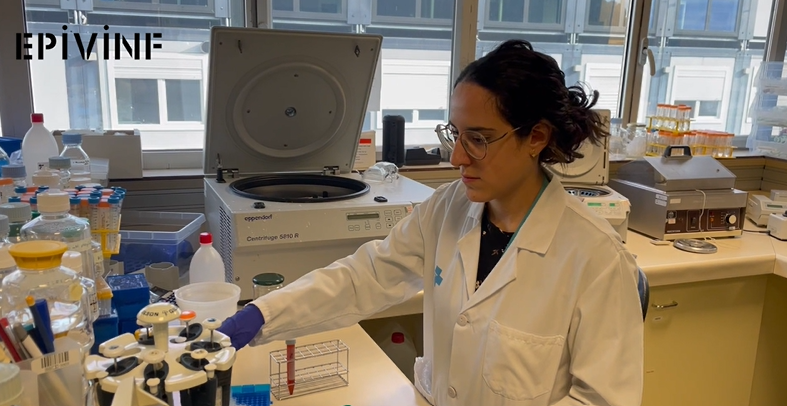
Sonia Villanueva is a postdoctoral researcher at IrsiCaixa and is also involved in our EPIVINF project. In this interview, Sonia explains more about her work within our project and her experience as a postdoctoral researcher.
Why did you become interested in science?
Science was always a subject that interested me because it allows me to understand how certain things work and why they work. For me, it feels like putting together the pieces of a puzzle that I don’t yet know the shape of. At the same time, it allows me to explore different topics and understand how they are interconnected. I find that part very, very exciting.
What is your work within the EPIVINF project?
I’m mostly focusing on studying the epigenetic mechanisms in a long COVID cohort, particularly by interrogating data from different omics approaches.
This cohort is quite interesting because these people were infected with SARS-CoV-2, but after they resolved the infection, they were left with a series of neurological complaints and have not recovered even six years after the pandemic. Part of the work involves understanding which dysregulations occurred in the immune system that might contribute to the chronification of the disease, and what the implications are for the neurological health of these individuals.
The interesting thing about epigenetics is that it modifies gene expression without actually altering the underlying DNA sequence. These mechanisms can be affected by environmental factors and infectious diseases. In turn, they influence how and when proteins are expressed, which can affect the normal functioning of a cell and have serious implications for a person’s health.
It is important to understand where these epigenetic marks are located and which genes are affected by them. This is one of the things we are studying in this project, because some of the affected genes and proteins could be involved in disrupting neurological health. This gives us a better chance to identify potential factors that might contribute to the chronification of the disease, particularly by identifying proteins or genes that may have serious implications for neurological health.
What advice would you give to someone who is about to start a postdoc?
My advice would be to be patient, to truly enjoy the science you are producing, and to remember your love for science and why you are doing it.
It is also important to remember that at this stage of your career, there are additional responsibilities beyond research, such as writing grants and establishing collaborations. So be patient with yourself and keep in mind that this is not a sprint, it is a marathon. Be kind to yourself and enjoy the process.