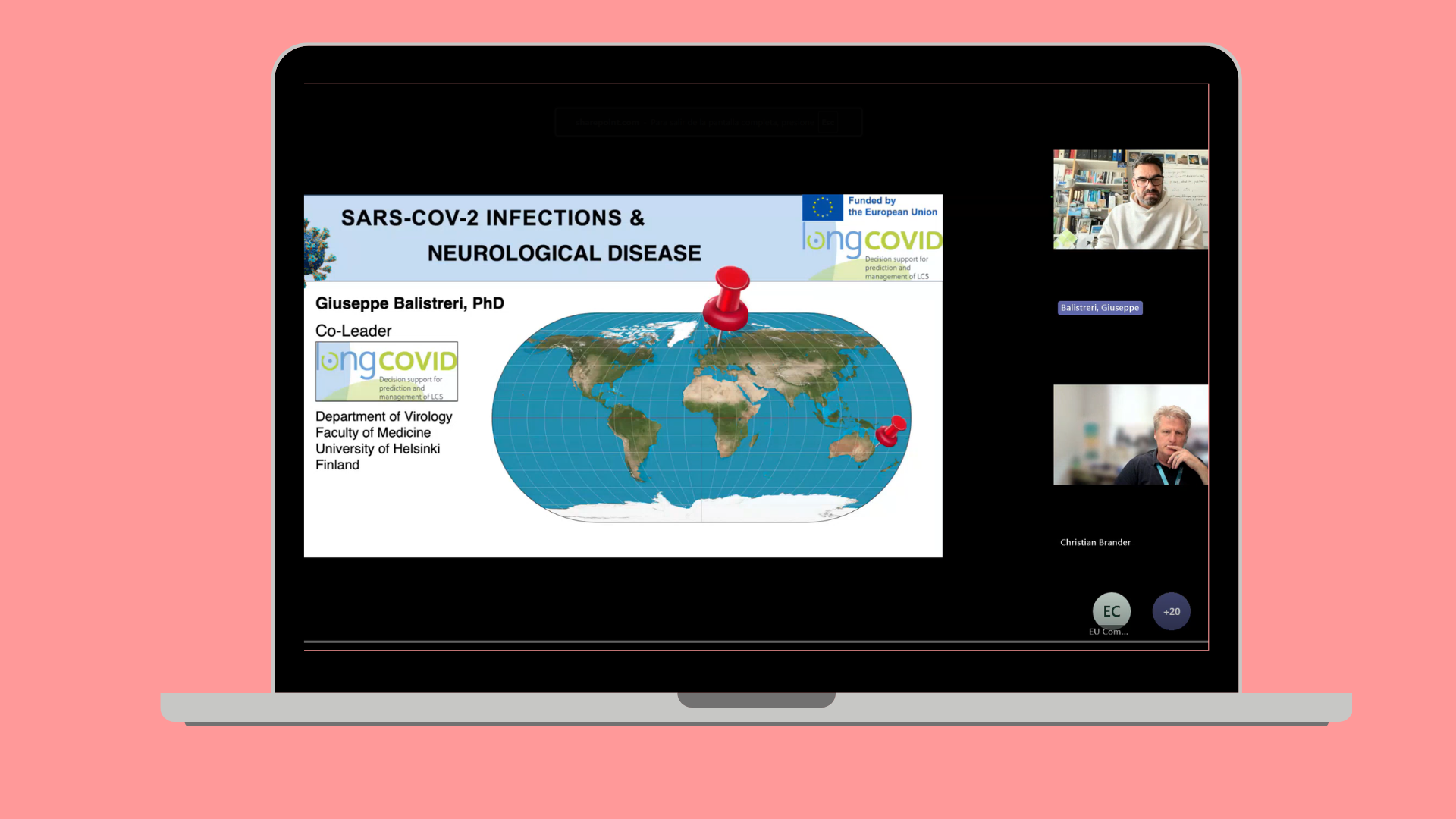
In our latest webinar on “Epigenetics and Viral Infections,” Giuseppe Balistreri, co-coordinator of the Long COVID project presented evidence about whether SARS-CoV-2 can infect the brain and if this infection could explain long COVID symptoms.
He explained that, based on a wide range of studies, including patient data, lab-grown mini-brains (organoids), virology experiments, and animal research, SARS-CoV-2 does not behave like viruses that are known to actively infect the nervous system, such as rabies or Zika. Those viruses can enter brain cells, multiply, and spread through the nervous system. In contrast, SARS-CoV-2 does not appear to efficiently infect or spread within brain tissue.
One key reason is that most brain cells do not have enough of the “entry proteins” the virus needs to get inside them. In laboratory studies using human neurons and brain organoids, infection was extremely rare, well under 1%. Even when infection did occur, the affected cells tended to die quickly, which stops the virus from spreading further.
In special laboratory conditions where brain cells are genetically modified to produce large amounts of the virus’s entry proteins, the virus can infect and damage them. However, this does not reflect what is normally seen in the human brain.
Researchers also sometimes detect traces of viral genetic material or proteins in the brains of people who died from severe COVID-19. These cases are usually older patients with very serious, body-wide illness. In those situations, damage to the blood- brain barrier may allow viral fragments to enter the brain. This is different from what is seen in most long COVID cases.
Animal studies support the same conclusion: in standard models, the virus does not naturally infect the brain. Brain infection only appears in genetically engineered animals that are artificially made highly susceptible, which is not comparable to normal human biology.
Overall, Balistreri suggested that long COVID is unlikely to be caused by the virus actively persisting and multiplying in the brain. Instead, current evidence points toward other possible mechanisms, such as ongoing immune system changes, inflammation throughout the body, changes in cell energy production, and in some cases the reactivation of dormant viruses like Epstein–Barr virus.
He emphasized that long COVID is real and can be debilitating, but it is probably not a single disease with a single cause. Because persistent brain infection does not seem to be a major factor, antiviral drugs like Paxlovid have shown limited benefit once long COVID is already established. Future treatments may need to focus more on calming immune dysfunction and restoring normal cellular and metabolic function after the initial infection.